![EV New logo_2021_Dark BG.svg]](https://knowledgebase.ev.uk/hubfs/EV%20Logos%202021/EV%20New%20logo_2021_Dark%20BG.svg)
What you are seeing here is the diversification benefit of investing across a selected amount of funds. The example below shows the issue and the explanation given by our Actuarial team.
Our actuarial team have looked into the below investments and have identified that each of the individual funds have produced a 5 or a 5+ Risk score but as a overall portfolio this has produced a Risk score of a 4.
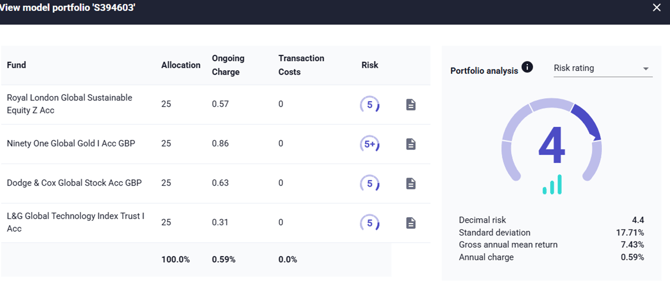
Ninety One Global Gold I Acc GBP fund is invested in Gold, and hence its 98.1% in commodities, whereas the other funds are equity based. (See the table below)
|
Fund Name |
Fund Code |
US Equity |
Commodities |
European Equity |
UK Equity |
Global Emerging Markets Equity |
Japan Equity |
Asia ex-Japan Equity |
Cash |
|
Royal London Global Sustainable Equity Z Acc |
SFDB |
59.730 |
|
11.750 |
17.180 |
9.040 |
2.300 |
|
|
|
Ninety One Global Gold I Acc GBP |
AEE1 |
|
98.100 |
|
|
|
|
|
1.900 |
|
Dodge & Cox Global Stock Acc GBP |
MCB2 |
53.550 |
|
20.000 |
9.800 |
11.900 |
2.600 |
0.250 |
1.900 |
|
L&G Global Technology Index Trust I Acc |
L559 |
86.485 |
|
4.580 |
|
5.900 |
2.690 |
0.345 |
|
So, the Ninety One Global Gold I Acc GBP fund is going to be diversifying away from the equity risk of the other funds (and vice versa).
The impact of this is that there is a small diversification benefit across the portfolio, hence the risk rating of the portfolio is lower than the straight average of each of the individual funds.